A to Z index
1. Acetate material

2. ADD power

ADD is used in bifocal, Multifocal glasses, reading glasses.
It represents the additional power over the distance prescription.
3. Amblyopia
Amblyopia is an inability to see clearly through one eye.
It arises during childhood, typically when the nerve pathway between the brain and eye doesn’t develop normally, making the eye unable to “learn” how to see correctly.
Amblyopia is more commonly referred to as “lazy eye” (though is also considered derogatory, so we will use the scientific term)
4. Anti-reflective coating

This treatment is recommended for those who work with computers, and keeps visual clarity in direct light/daylight without direct light rays/reflections disrupting your vision
5. Astigmatism

Astigmatism is a common optical condition causing blurry vision
The blurry vision is caused by the curve of your cornea being slightly irregular in shape,
preventing light from focusing properly on the back of the eye.
This prevents you from seeing with perfect sharpness.
A pair of glasses tailored for astigmatism is the main remedy.
6. Axis
“Axis” is the number on your prescription that determines
the direction of your astigmatism correction.
7. Base curve (contact)
The base curve is also included on a contact lens prescription that helps the lens fit properly. (between 8.3~9.2)
8. Blue Light Lenses

Blue light is emitted by the sun as well as screens on computers, phones, and other electronic devices. Our blue-light-filtering lenses filter out a higher percentage of blue light than any other optical lenses we offer.
9. Cataract
Eye condition where the lens of the eye becomes cloudy with age, causing blurry and cloudy vision and increased sensitivity to light. Cataracts are not only caused by aging, but also extensive exposure to UV light. This is usually treated with eye surgery to replace the blurry lens with an artificial clear lens. Regular eye exams are recommended to detect symptoms of cataracts as early as possible, where early cataracts can be managed with stronger lighting and eyeglasses to help improve the vision.
10. Contact Lens


Colored contact lenses are also sold here, from the brand Alcon colored lenses. Colored contacts are for giving your eyes a different color from your natural irises.

11. Diameter

You may find a diameter measurement included on a contact lens prescription, which is just the width of a contact lens in 'mm'.
12. Dilation
Eye care professionals will sometimes dilate your pupils during an exam to get a better look at your retina.
This simply means that your pupils will be widened (or dilated), usually using special dilating eyedrops.
The downside of getting your eyes dilated is that it makes your vision blurry and your eyes extra-sensitive to light for a few hours, or sometimes a bit longer.
Sunglasses help a bit. ( Safety tip: It’s not a good idea to drive for several hours after)
13. Diopter
A diopter is a unit of measurement, like “gram” or “ounce.”
Instead of measuring mass, it measures the refractive power of a lens in other words, it measures optical power.
14. Eyes

The orbs on your face that give you an excuse to wear cool glasses.
The eye is an insanely complex organ, but it helps to think of it like a camera: It has a lens, it collects incoming light, and it provides an image that your brain interpret.
15. Fitting
Pupils should be near the center of the lens.
Lenses shouldn’t extend past the side of your face.
Eyebrows should not be inside the glasses.
When you smile, your cheeks shouldn't push the frames up.
Frames shouldn’t slide down your nose.
16. Glasses

17. Health Spending Account
Sort of like FSAs, health spending accounts (or HSA for short)
allow you to set aside pre-tax money to use on approved health care expenses like, say, prescription glasses or prescription sunglasses, contacts...
18. High-index lenses
“High-index lens” is a type of thin plastic lens
that comes in handy for some higher prescriptions.
Being able to see clearly greatly improves your quality of life.

19. Hyperopia : Farsightedness

20. Macular Degeneration
A common eye condition that affects the central part of your vision, caused by damage to the retina, the part of the eye that sharpens vision, particularly for reading, driving, and recognizing faces.
There are 2 types of macular degeneration:
Dry AMD is caused by aging, when the retina becomes thin with age
Wet AMD is caused by abnormal blood vessels growing under the retina and leaking fluid.
21. Monovision

Monovision is sometimes prescribed in contacts.
It’s a refractive correction that has one lens for distance and the other lens for near vision.
So you could almost treat monovision contacts as having 2 cameras with different powers, with one camera for seeing farway and one camera for seeing up close to read
22. Myopia: Nearsightedness

This condition is “myopia.” If you’re sitting in the back
row of a movie theater and the screen is blurry?
that would be nearsightedness.
23. Nose pads

24. Optician
An optician is an eye care professional who is trained to interpret,
fit, and dispense prescription eyewear.
They don’t provide you with the prescription itself, but they make sure everything is up and running perfectly after you’ve gotten a prescription from an eye doc.
25. Optometrist
An optometrist is the doctor who gives you a prescription for glasses and or contacts. They can also diagnose eye diseases and prescribe some medications.
26. Ophthalmologist
In addition to being an incredibly hard word to spell, an ophthalmologist is a medical doctor who specializes in the treatment and diagnosis of eye diseases,
as well as in eye surgery. This person can also prescribe medications, glasses, and contacts.
27. Plano
“Plano” refers to a lens without a prescription. Just a plain ole’ plano.
28. Polarized lenses

Polarized lenses eliminate glare, making it easier for you to see
without straining your eyes. How do they work? Physics, punk! Light waves vibrate in different directions, and most of the light waves that cause “glare” those shiny reflections off a pool or a highway are horizontal. Polarized sunglasses have teensy vertical filters that prevent horizontal light waves from entering. Voilà: no glare. It’s so simple, yet so cool.
29. Polycarbonate
Polycarbonate is an über tough transparent plastic with exceptional impact resistance. (It won’t break if you drop it, unlike eggs, crystal vases, fine china, water balloons, etc.)
30. Prescription
A prescription is a formula for making the best pair of eyeglasses for you.
Think of it like a recipe with different ingredients: You’ve got your sphere (to indicate the strength of the lens you need), your cylinder (which indicates the lens power needed to correct astigmatism), and your axis (which indicates
where to place the lens correction for astigmatism), among other pieces of information.
31. Prism
This is a piece of information that may appear on your prescription.
If your doctor includes a prism correction on your prescription,
you’ll see a little triangle symbol next to it, like this: ∆
32. Progressives
Progressive lenses are like a fun “two-for-one” deal,
offering multiple focal corrections all in the same lens
(distance correction on top, intermediate in the middle,
and reading correction on bottom).
This means you can see your whole field of vision
without switching between multiple pairs of glasses. 

33. Pupil

“Pupil” is a fun word to say. It’s the part of your eye that light passes through—the little hole right smack in the middle. Humans have circular pupils, but a lot of animals have crazy-shaped pupils, like geckos. We’re not even sure how to describe the shape of a gecko pupil. It’s almost like a piece of beef jerky.
Anyhow, back to science. Your pupils expand and contract depending on the light conditions surrounding you. When light is scarce, your pupil expands
34. Pupillary distance

Your pupillary distance is...drumroll please...the distance between your pupils.
35. Retina
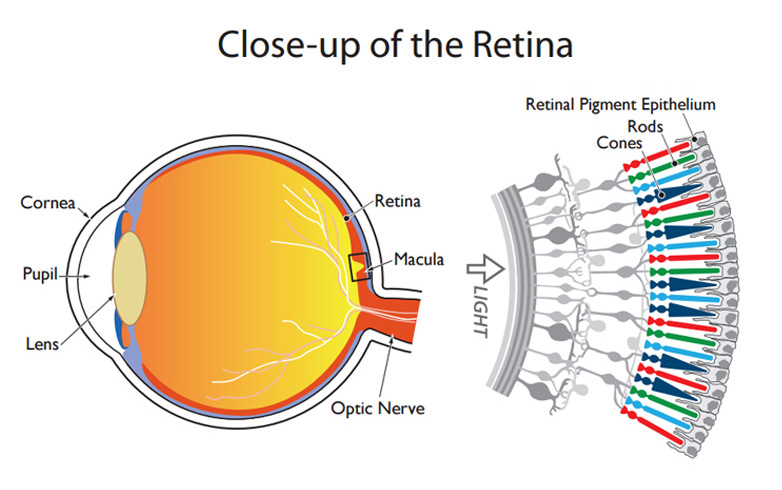
The retina is a light-sensing layer of tissue lining the inside of your eye.
36. Single-vision lenses
Single vision lenses correct for one field of vision (usually for distance or reading)
37. Sunglasses

38. Titanium
Titanium is a strong, durable substance that holds up well under force. (Just like you.) We use it to make glasses because it has a high strength-to-weight ratio, which makes it ideal for an item that rests on your nose. Also: Titanium never rusts.
Its symbol is Ti, like the rapper .
Titanium was discovered in 1791. Other fun things that occurred in 1791: Vermont became a state, the guy who invented Morse code was born, and the world’s first Sunday newspaper was published. Yeah, it was a good year.
39. Toric
Geometry geniuses may remember that toric means having two independent curves instead of one. What does this have to do with my eyes? You might ask. Well, toric contact lenses are used for people with astigmatism, so the prescription will have both a Cylinder (CYL) and an Axis value.
40. Transition

41. Ultraviolet light

Ultraviolet light is a form of electromagnetic radiation that surrounds us, but it’s not visible with the human eye. Our main source of UV light is the sun. (If you’re overexposed to UV light, you can get a sunburn. Be safe out there, guys.)
42. Visual acuity

Visual acuity is a schmancy way of saying “how well you can see.”
You may have heard the term “20/20 vision” tossed around. That term describes “normal” vision. If you have 20/20 vision, you can see at 20 feet what a person with normal vision would see at 20 feet. It’s possible to have better than average vision—some people, for example, have 20/15 vision, which means they can see at 20 feet what most people can only see at 15 feet! (#jealous).
43. Visual field

Your visual field (or “field of vision”—same thing) is the area that you are able to see when your eyes are in one fixed positions.
44. WOW~
